Two years ago, when I was going through the Google Data Analytics Certificate, I discovered Google’s 6-step framework. It quickly became my favorite. Ask, prepare, process, analyze, share, act. It felt clean. Logical. Almost comforting. I used those six steps in multiple projects. I even started thinking about my daily tasks through that structure. But recently, I noticed something. This is not exactly how my real work looks. Because data analyst tasks are rarely just one neat, linear journey from question to action. They come in all shapes and sizes. Some tasks are ad hoc. A message pops up: “Hey, can you quickly check why registrations dropped yesterday?” No clear question. No perfect dataset. And definitely no time to follow six elegant steps. Other tasks are recurring reports. The weekly dashboard. The monthly revenue numbers. The daily fraud alerts. These are structured, repetitive, and quietly critical for the business. Then there are the deep dives. The kind of analysis where you spend days trying to answer one big question: Why are users churning? Which campaign actually works? What is driving this sudden spike? And sometimes, you’re not analyzing at all. You’re building dashboards, fixing broken queries, cleaning messy data, or updating logic that nobody touched for two years. Not every task starts with a perfectly defined “Ask” step. And not every task ends with a clear “Act.” That’s when I started wondering: If the work looks so different from day to day, are there other ways to think about the analysis process? So that’s when I dug a little deeper and discovered other frameworks. OSEMN, CRISP-DM, Agile analytics and a few more. The core logic was basically the same: You have a problem. You have data. You try to make sense of it. That’s literally what the job title says. Data. Analyst. No big mystery there. So if the logic is the same everywhere, what’s actually different? THE FOCUS. Google’s 6 steps: clean and intuitive CRISP-DM: business comes first OSEMN (Awesome) : the analyst’s real workflow Agile analytics: no real ending So what’s the real difference? All these frameworks follow the same core logic: understand the problem, work with data, extract insight, drive action. The difference is in what they emphasize. Google focuses on clarity and communication. In real life, most analysts don’t follow just one of them. We borrow a little from each, depending on the task, the team, and the deadline. And sometimes, the framework is just: “Can you quickly check this before the meeting?” I still use it today for my portfolio projects. And honestly, parts of it live inside my day-to-day tasks too. But recently I caught myself thinking: Is this really the only way analysts work? So I started looking into other frameworks. And, well… apparently there are quite a few. Google’s 6 steps: clean and intuitive So now I’m curious:
It was linear. Very intuitive. Easy to follow. Each step led naturally to the next one.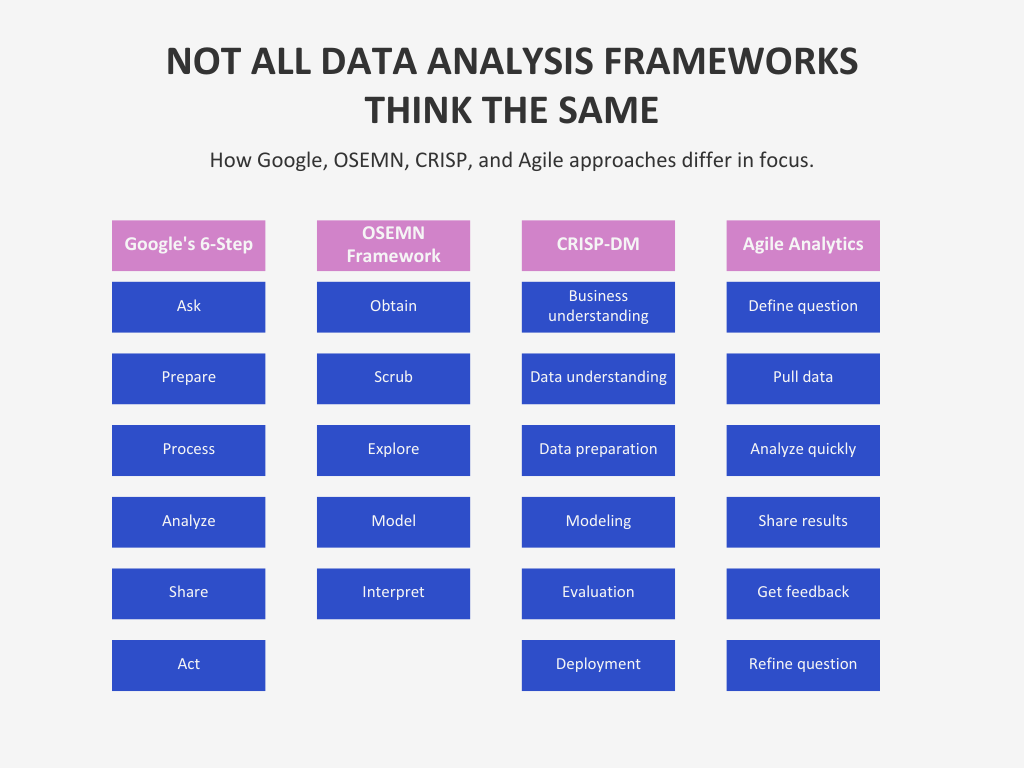
Google’s framework is the one I started with:
Ask → Prepare. → Process. → Analyze. →Share. → Act.
It’s very linear. Very clean. Very comforting. Each step flows naturally into the next one. Perfect for learning. Perfect for structuring projects. Perfect for explaining your work to others. It’s less about the technical struggle, and more about the communication and decision side of analysis.
In CRISP-DM, everything starts with business understanding.
Not just: “What’s the question?” But: “Why does this question matter at all?” You’re expected to understand the real business impact behind the task. Revenue, growth, churn, fraud, retention — something real, not just numbers in a table. And the last step is deployment. Not just sharing results, but actually putting them into use: a model in production, a dashboard people check daily, a report that drives decisions. In other words, the project doesn’t end with insight. It ends when the business actually uses it.
OSEMN feels very different. Less corporate. More… honest.
It goes: Obtain. → Scrub. → Explore. → Model. → Interpret.
No big speeches about strategy. No fancy deployment phase. Just the reality: First, you get the data. Then you clean the mess. Then you explore it. Only after that do you build something meaningful. OSEMN quietly admits something most analysts already know: You’ll probably spend more time scrubbing data than doing the “cool” analysis.
Agile doesn’t really believe in a final step.
It’s more like a loop: Define a question → Pull some data → Run a quick analysis → Share the result → Get feedback → Refine the question → Repeat.
No perfect structure. No grand finale. Just fast cycles and constant adjustments. This is very common in product, marketing, or growth teams, where decisions need to happen quickly and questions change every week.
OSEMN reflects the technical reality of the analyst’s workflow.
CRISP-DM puts business context and deployment at the center.
Agile prioritizes speed and iteration.
Two years ago, when I was going through the Google Data Analytics Certificate, I discovered Google’s 6-step framework. It quickly became my favorite. It was linear, very intuitive, easy to follow. Each step naturally led to the next one.
Ask → Prepare → Process → Analyze → Share → Act.
Simple. Clean. Comforting.
If we’re honest, the core logic is always the same, right? You have a problem. You have data. You try to make sense of it. That’s literally the job description. But the focus changes a bit:
CRISP-DM: business comes first
OSEMN (yes, it really stands for “Awesome”): admits that scrubbing and exploring take most of the time
Agile analytics: no real ending, just loops and more loops
Which framework actually reflects your real workflow?